A recent cyber fraud incident highlighted how employees at an organisation reportedly lost approximately ₹3.5 crore after opening a malicious ZIP file received via WhatsApp. The message, disguised as communication from a senior executive, appeared authentic and time-sensitive.
What initially looked like a routine file-sharing request escalated into a major financial and cybersecurity incident. The attack highlights a growing trend where cybercriminals prioritise social engineering and impersonation over exploiting technical vulnerabilities, manipulating trust to compromise organisations.
Once such an attack succeeds, the priority shifts from prevention to investigation, containment, and recovery. This is where Digital Forensics and Incident Response, or DFIR, becomes a critical business capability.
Key Takeaways:
- The growing use of WhatsApp for workplace communication has made it an attractive entry point for attackers seeking to exploit organisational trust.
- Malicious ZIP files remain one of the most effective methods of malware distribution.
- Social engineering attacks exploit trust, urgency, and organisational hierarchy.
- Rapid incident response helps in reducing financial, operational, and reputational damage.
- Digital forensic capabilities enable organisations to uncover how an attack occurred, assess the scope of damage, and reduce the risk of recurrence.
Understanding the WhatsApp Boss Scam
Media reports suggest that employees received WhatsApp messages that appeared to come from their manager or a senior executive. The message included a ZIP file and instructed the recipients to open it.
Once opened, the ZIP file is believed to have installed malware on the victims' systems, enabling attackers to carry out unauthorised transactions worth approximately ₹3.5 crore. The incident appears to follow a pattern increasingly observed across industries:
- Executive impersonation
- Delivery of malicious attachment
- Malware installation
- Credential theft or remote access
- Unauthorised financial transactions
The attackers did not necessarily exploit a software vulnerability; they exploited human behaviour.
Why Business Communication Platforms Have Become Prime Targets
The widespread use of WhatsApp and other messaging applications has transformed workplace communication, while creating new opportunities for cybercriminals to target organisations.
Informal Workplace Communication
The informal nature of messaging applications often causes employees to lower their guard compared with email.
Lack of Security Monitoring
While most organisations regularly monitor emails, they have limited access to interactions taking place on personal messaging platforms.
Increased Use of Mobile Devices
Employees frequently use personal devices for work-related communication, which makes it difficult to monitor, secure, and control business communications.
Time-Sensitive Decision Making
Messages from senior executives are usually time-sensitive and demand immediate action, which reduces the chances for verification.
Cybercriminals exploit each of these factors to increase the success rate of attacks.
The Rising Cost of Social Engineering Attacks
Incidents of executive impersonation are becoming increasingly expensive because the financial loss rarely ends with the fraudulent transaction.
According to the 2025 Verizon Data Breach Investigations Report, human involvement, including social engineering and credential misuse, remains a leading factor in security incidents worldwide.
IBM’s Cost of a Data Breach Report 2024 reveals that the average cost of data breach in the world is estimated to be USD 4.88 million, which marks a 10% rise as compared to the last year.
The financial impact extends beyond immediate losses and often includes:
- Business disruption
- Cost of investigation
- Regulatory penalties
- Legal costs
- Loss of consumer trust
- Reputational damage
For many organisations, the secondary impact often outweighs the primary financial loss.
What Happens After a Cyber Incident?
Incidents like this often raise the same critical questions. Before systems can be restored or regulatory obligations are fulfilled, organisations need to understand exactly what happened. Even organisations with mature cybersecurity controls can fall victim to such attacks. The real measure of preparedness lies in how quickly they can investigate, contain, and recover from the incident.
An effective response requires answering a few critical questions:
- How did the attackers gain access?
- Which systems and assets were affected?
- Was any sensitive data accessed or leaked?
- Do the attackers still have a presence in the environment?
- What evidence needs to be preserved?
- How can operations be restored without introducing further risk?
These questions can be answered through a structured Digital Forensics and Incident Response (DFIR) process.
What Is Digital Forensics and Incident Response (DFIR)?
Digital Forensics and Incident Response is a specialised cybersecurity discipline focused on:
- Investigating the root cause of a cyber incident
- Identifying affected systems, users, applications, and data
- Preserving digital evidence in a forensically sound manner
- Containing active threats and removing attacker access
- Supporting recovery, regulatory reporting, insurance claims, and legal proceedings
- Strengthening controls to reduce the likelihood of recurrence
.png)
DFIR is not only an investigative function, but a critical business capability that enables organisations to minimise operational disruption, maintain stakeholder confidence, and recover from cyber incidents with greater resilience.
How DFIR Helps After a Cyberattack
Incidents involving malicious files and executive impersonation are usually time-sensitive.
A structured DFIR engagement helps organisations:
- Identify the Initial Point of Compromise
DFIR helps determine which user, endpoint, or account first interacted with the malicious file, allowing investigators to trace the origin of the incident. - Reconstruct the Attack Timeline
Investigators can reconstruct how the attack unfolded, how the malware entered the environment, and whether it spread laterally to other systems. - Assess the Scope of Impact
DFIR helps identify affected users, endpoints, applications, accounts, and data to determine the full scope of compromise. - Preserve Evidence
Acquiring digital evidence helps in internal investigations, regulatory compliance, making claims, and even conducting legal actions. - Contain Ongoing Threats
Isolation of the compromised system, removal of the malware, and restricting the attackers from getting back into the environment. - Strengthen Future Defences
Address security gaps through improved controls, policies, user awareness training, and monitoring to reduce the risk of future incidents.
Without a forensic investigation, organisations may only address the immediate symptoms of an attack while leaving the root cause unresolved, increasing the likelihood of recurrence.
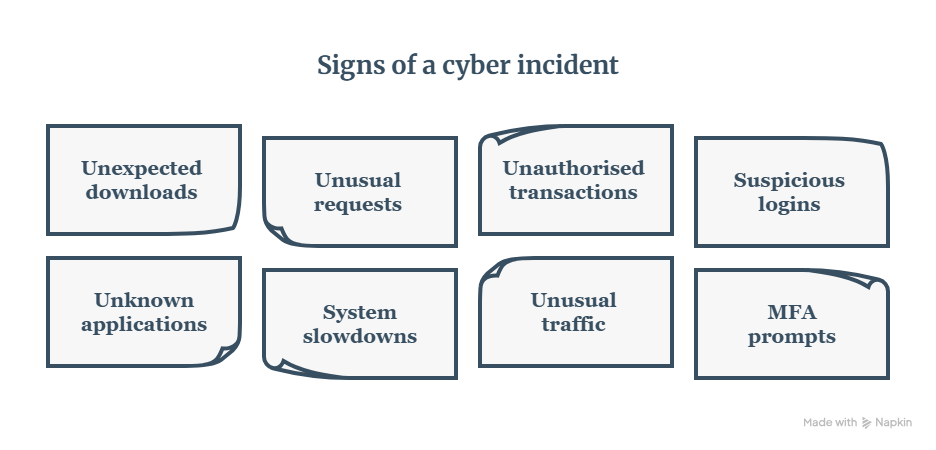
Common Indicators of Cyber Attacks
Netrika's Approach to Digital Forensics and Incident Response
We help organisations respond quickly and effectively to cyber incidents through our Digital Forensics and Incident Response (DFIR) services. Our team combines malware analysis, network forensics, and legally admissible evidence preservation to identify how attackers gained access, contain the incident, and prepare documentation required by banks, regulators, insurers, and law enforcement.
Beyond investigation, we work with finance and IT teams to strengthen payment approval processes, develop incident response plans, deliver security awareness training, and provide post-incident recommendations to reduce future risk.
With over 18 years of experience, we have supported Indian corporates, financial institutions, and multinational organisations through complex cyber incidents. As a CERT-In-empanelled and ISO-certified organisation, we understand that the first few hours of an incident are critical. A coordinated response can help contain the attack, minimise financial and operational disruption, and strengthen resilience against future threats.
Cyber Preparedness Is More Than Prevention
The WhatsApp Boss Scam reveals that even a single successful cyberattack can cause significant financial and operational disruption. While preventive controls are essential, organisations must be prepared to respond effectively when an incident occurs.
An effective cyber incident response framework should include well-defined roles and responsibilities, escalation procedures, forensic readiness to preserve digital evidence, access to specialised DFIR expertise, and regular incident response exercises. Collectively, these measures enable organisations to detect, contain, and recover from cyber incidents more effectively while minimising business disruption and supporting regulatory and legal requirements.
When a cyber incident occurs, the ability to respond quickly and make informed decisions often determines whether a minor incident becomes a large-scale business crisis.
FAQs
What is a WhatsApp Boss Scam?
A WhatsApp Boss Scam is a form of executive impersonation fraud in which attackers pretend to be senior leaders and manipulate employees into opening malicious files, sharing credentials, or transferring funds.
Why are ZIP files commonly used in cyberattacks?
ZIP files are commonly used because they can conceal malicious payloads, compress multiple files, and sometimes bypass basic security checks.
What is Digital Forensics and Incident Response?
DFIR is the process of investigating, containing, and recovering from cybersecurity incidents while preserving digital evidence for internal, regulatory, insurance, or legal purposes.
Can digital evidence be recovered after a cyberattack?
Yes. Digital forensic investigators can often recover and preserve evidence from compromised systems, network logs, email records, endpoints, and other digital sources. This evidence supports internal investigations, regulatory reporting, insurance claims, and legal proceedings.
Which industries benefit from DFIR services?
Any organisation that handles sensitive data, financial transactions, customer information, intellectual property, or critical business operations can benefit from DFIR services.
Is Your Organization Prepared for a Boss Scam or Ransomware Attack?
Strengthen Your Cyber Resilience with Netrika's Digital Forensics and Incident Response Services
Our DFIR team helps you build a tested and verified protocol before an attacker tests it for you.
Visit: https://www.netrika.com | Call: 1800 121 300000 | Email: trust@netrika.com