Hiring the right talent goes beyond evaluating skills, qualifications, and interview performance. Before onboarding a candidate, organizations must verify that the information shared during the hiring process is accurate, authentic, and reliable. This is where the Background Verification process (BGV) plays a critical role. In today's business environment, where organizations face increasing risks related to identity fraud, resume discrepancies, document forgery, and regulatory compliance, background verification has become an essential component of risk management rather than just an HR formality.
Key Takeaways
- The background verification process enables organizations to validate candidate information before making informed hiring decisions.
- A structured verification process helps mitigate hiring risks while strengthening workplace integrity and organizational security.
- Identity, education, employment, address, and criminal record checks provide evidence-based insights into a candidate's credentials.
- Timely background verification supports regulatory compliance, enhances trust, and promotes informed recruitment decisions.
- Robust background screening safeguards organizations against fraud, operational disruptions, financial losses, and reputational risks.
A structured verification process helps employers validate key candidate information, identify potential risks before hiring, strengthen workplace integrity, and ensure compliance with applicable legal and industry standards. By conducting thorough due diligence, organizations can make informed hiring decisions, reduce the likelihood of fraudulent appointments, and build a workforce founded on trust, transparency, and accountability.
What Does the Background Verification Process Actually Cover?
What is BGV (Background Verification Process)? According to us, it is a comprehensive background verification process that goes beyond validating basic candidate information. A structured BGV process provides organizations with evidence-based insights that support informed hiring decisions while mitigating potential business risks. It also helps verify the authenticity of candidate credentials, strengthen workplace integrity, support regulatory compliance, and enable organizations to build a trusted, secure, and resilient workforce through informed recruitment decisions.
- Identity verification: Confirms the authenticity of government-issued identity documents to establish the candidate's identity.
- Education and employment verification: Validates academic qualifications, previous employment, designations, and work history through reliable sources.
- Address and criminal record checks: Verifies residential details and, where legally permissible, identifies potential legal or compliance concerns.
- Role-specific screening: May include reference checks, credit history, professional licence verification, or regulatory screening based on business requirements.
- Risk-focused reporting: Consolidates verified findings into a structured report, enabling organizations to strengthen due diligence, reduce hiring risks, and build a trusted workforce.
Depending on organizational requirements and industry standards, the process may include identity, address, education, employment, criminal record, reference, and other relevant verification checks. By independently validating candidate information, organizations can minimize recruitment risks, prevent fraudulent hiring, protect their reputation, and ensure greater transparency and consistency throughout the hiring process.
Why Indian Employers Can No Longer Skip It
The background verification process has evolved from being a recruitment formality to a critical business risk management practice. With increasing cases of resume fraud, identity theft, forged credentials, and employment misrepresentation, organizations can no longer afford to overlook a structured BGV process. Why does it really matter:
- Reduces the risk of negligent hiring, insider threats, financial fraud, and reputational damage.
- BGV verification helps organizations meet compliance requirements and demonstrate due diligence.
- Validates candidate credentials through reliable and authorized sources.
- Strengthens trust among employees, clients, partners, and stakeholders.
- Supports long-term governance by enabling secure, compliant, and risk-informed recruitment practices.
An effective BGV process enables Indian employers to make informed, evidence-based hiring decisions while safeguarding workplace integrity and organizational credibility. It also strengthens compliance, minimizes hiring risks, protects organizational reputation, and fosters long-term trust among employees, clients, and stakeholders.
Netrika's Approach to Background Verification
At Netrika, the background verification process is viewed not merely as a recruitment checkpoint, but as a strategic risk management function. Our structured background verification process (BGV process) enables organizations to hire with confidence, strengthen workplace integrity, and make informed decisions through accurate, compliant, and evidence-based verification. By delivering reliable, risk-focused insights, we help organizations reduce hiring risks, reinforce compliance, protect business reputation, and build a trusted, resilient workforce.
Our approach is built on:
- Comprehensive verification: A robust background verification process covering identity, education, employment, address, criminal records, and role-specific checks tailored to organizational requirements.
- Accuracy and compliance: BGV verification is conducted through reliable sources while adhering to applicable legal, regulatory, and data privacy requirements.
- Risk-based assessment: Our BGV process delivers actionable insights that help organizations identify discrepancies, mitigate hiring risks, and support informed recruitment decisions.
- Trusted outcomes: A structured verification framework that protects organizational reputation, enhances stakeholder confidence, and contributes to building a secure and resilient workforce.
Our technology-enabled approach, supported by domain expertise and regulatory compliance, ensures every verification is conducted with accuracy, transparency, and consistency, helping organizations make confident hiring decisions while safeguarding long-term business interests.
How the Verification Cycle Runs, Step by Step
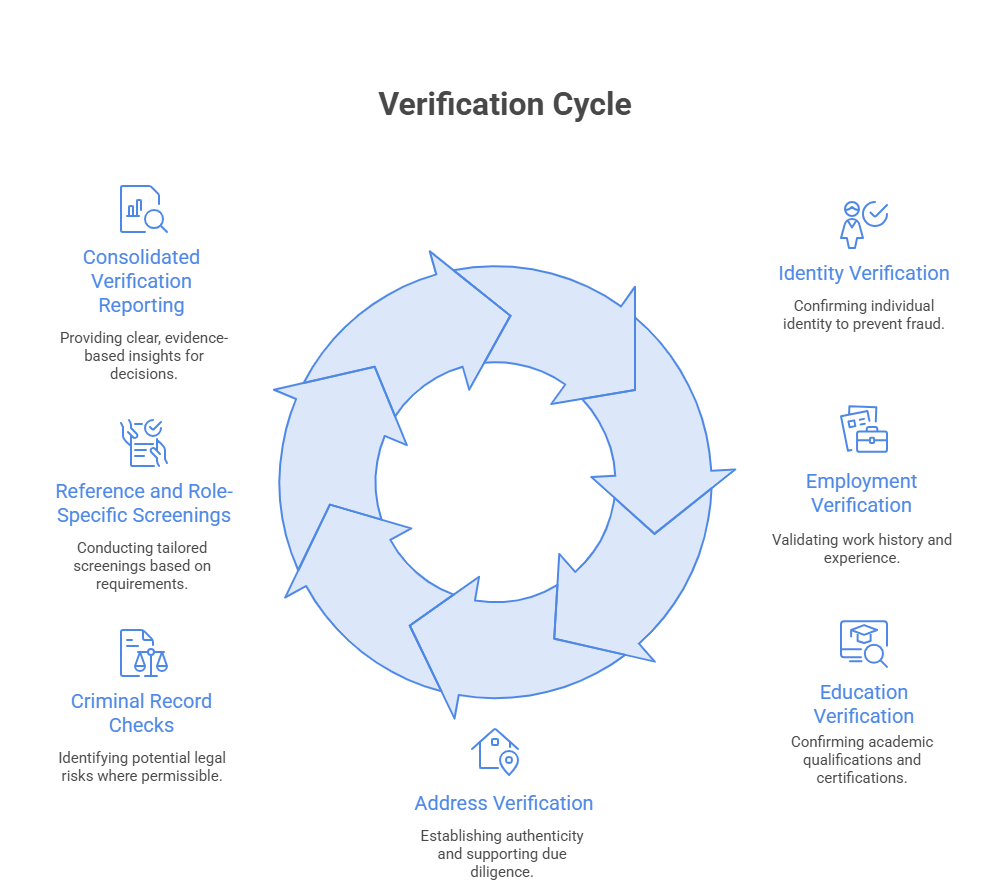
An effective background verification process cycle helps organizations validate candidate credentials, mitigate hiring risks, and strengthen workplace integrity through independent and reliable verification. Rather than relying solely on self-disclosed information, a structured BGV process enables organizations to assess multiple aspects of a candidate's profile, identify potential discrepancies, support regulatory compliance, and make informed, evidence-based hiring decisions. A comprehensive verification typically includes:
- Identity verification to reduce impersonation and identity fraud.
- Employment verification to validate work history and identify discrepancies.
- Education verification to confirm academic qualifications and certifications.
- Address verification to establish authenticity and support due diligence.
- Criminal record checks, where legally permissible, to identify potential legal risks.
- Reference and role-specific screenings based on industry, regulatory, or business requirements.
- Consolidated verification reporting to provide clear, evidence-based insights for confident hiring decisions.
Together, these BGV process steps and verifications help organizations strengthen compliance, reduce fraud, and build a trusted, resilient workforce. It also improves recruitment transparency, safeguards organizational reputation, reduces the likelihood of fraud, and helps build a trusted workforce capable of supporting long-term business growth and operational resilience.
Industries Where This Check Is Now Standard Practice
The background verification process has become a standard hiring practice across industries where trust, compliance, and business continuity are essential. As hiring risks continue to evolve, organizations increasingly rely on a structured BGV process to validate candidate credentials, strengthen workplace integrity, and support informed hiring decisions.
- Banking, Financial Services & Insurance (BFSI): Reduces financial fraud risks while supporting regulatory compliance.
- Information Technology (IT), ITES & Global Capability Centers (GCCs): Protects sensitive data, intellectual property, and client confidence.
- Healthcare & Pharmaceuticals: Verifies professional credentials for roles impacting patient safety and regulatory standards.
- Manufacturing, Engineering & Infrastructure: Strengthens workforce reliability and minimizes operational risks.
- Retail, E-commerce & Logistics: Supports secure hiring across customer-facing, warehouse, and supply chain operations.
- Telecommunications & Media: Safeguards critical infrastructure, customer information, and business continuity.
- Education & Research: Validates academic and professional credentials to maintain institutional credibility.
- Government, Public Sector, Consulting & Professional Services: Reinforces governance, due diligence, and organizational trust through evidence-based hiring practices.
Background Verification Under Indian Law and Beyond
Background verification in India is governed by evolving data privacy, employment, and sector-specific regulations. A compliant background verification process enables organizations to protect candidate data, strengthen due diligence, and make informed hiring decisions while meeting regulatory obligations.
- Digital Personal Data Protection Act, 2023 (DPDPA): Mandates explicit candidate consent, purpose-specific data collection, and responsible handling of personal information throughout the background verification process, including the secure handling of BGV documents.
- Supporting Legal Framework: The IT Act, 2000, Indian Contract Act, 1872, and sector-specific regulations from RBI, SEBI, and IRDAI establish the legal foundation for a compliant BGV process and verification requirements.
- Data Privacy & Security: Secure data processing, encryption, and controlled access help minimize risks of unauthorized access, data leakage, and misuse of candidate information.
- Compliance-Driven Verification: Organizations should implement a standardized background verification process aligned with applicable legal, regulatory, and industry-specific obligations.
Why Organisations Trust Netrika With Their Screening
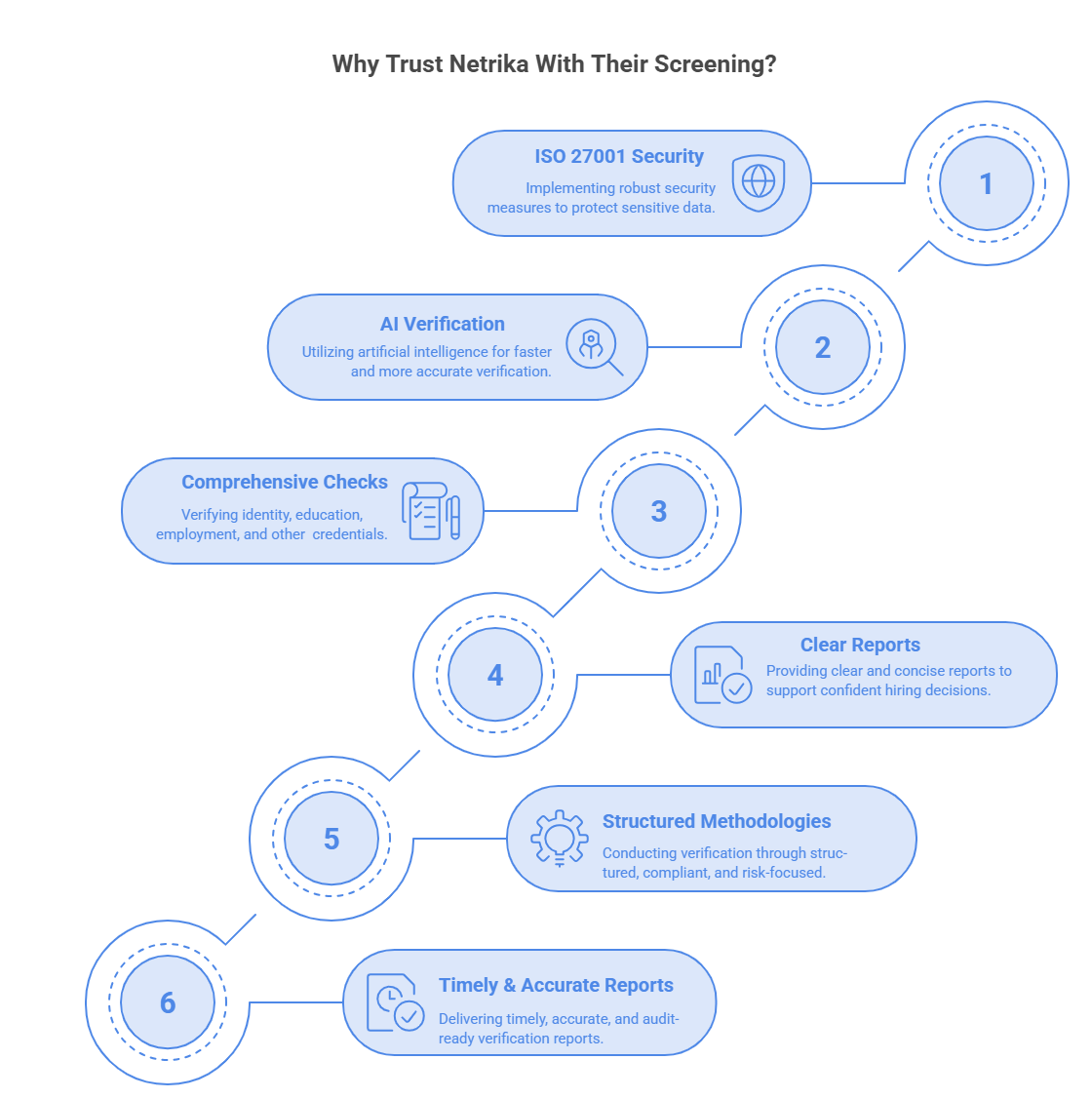
A strong background verification process is one of the smartest ways to reduce hiring risks and build a trustworthy workforce. When you're hiring, you need more than what a resume or interview can tell you. That's why organizations rely on Netrika for a secure BGV verification and accurate BGV process that helps verify candidate information while protecting business integrity. We follow Indian legal and regulatory requirements such as:
- Protecting sensitive data through ISO 27001-certified security practices.
- Use of AI to make verification faster and more accurate.
- Verify identity, education, employment, and other critical credentials.
- By providing clear reports that support confident hiring decisions.
- Conducting verification through structured, compliant, and risk-focused methodologies.
- Supporting organizations with timely, accurate, and audit-ready verification reports.
Related Insights from Netrika Consulting
As organizations across India continue to strengthen their hiring practices, background verification has become a strategic component of risk management rather than just a compliance requirement. Netrika Consulting supports this shift through structured, legally compliant, and technology-driven verification solutions that enable organizations to make informed hiring decisions.
According to publicly available information, Netrika has established a strong presence in the background verification industry through key milestones:
- 300+ corporate clients served across India, spanning industries such as IT, BFSI, pharmaceuticals, manufacturing, retail, logistics, e-commerce, and professional services.
- 1 million+ background verifications completed, demonstrating extensive experience in handling large-scale and diverse hiring requirements.
- 9 key verification services offered, including identity, address, employment, education, criminal record, reference, biometric, company legitimacy, and global database verification.
The growing adoption of background verification in India further highlights its importance in modern recruitment:
- Nearly 80% of Indian employers conduct pre-employment background checks before onboarding candidates.
- 8% to 11% of screened candidates are found to have discrepancies in areas such as employment history, educational qualifications, identity, or address information.
By combining AI-enabled technology, forensic document examination, on-ground verification capabilities, and a structured multi-step verification framework, Netrika helps organizations strengthen compliance, reduce hiring risks, and build a trusted workforce with confidence.
Frequently Asked Questions
1. When does the background verification process begin?
The background verification process typically begins after a candidate accepts the job offer and provides the necessary documents and consent.
2. How long does the BGV process usually take?
The timeline varies depending on the scope of verification, but most standard checks are completed within 7–15 working days.
3. Can an employer conduct BGV verification without the candidate's consent?
No. The background verification process is generally carried out only after obtaining the candidate's explicit consent and the required information.
4. What documents are commonly required for background verification?
Organizations typically request identity proof, address proof, educational certificates, employment records, and other role-specific documents.
5. How is previous employment verified?
Employment details are usually verified through authorized channels such as previous employers, official employment records, or other reliable verification sources.
Why Does Pre-Employment Verification Matter Before Hiring in India?
Protect Indian Organizations Through Netrika's Background Verification Processes. Strengthen your hiring processes with Netrika's Trusted BGV Solutions.
Visit: www.netrika.com | Call: 1800 121 300000 | Email: trust@netrika.com




.jpg)