



Cyberattacks are no longer isolated and forgotten incidents; they have now become a major and growing concern for businesses and organizations. From data breaches to ransomware, these attacks can deeply hamper your organization’s IT systems. They can cause financial losses, expose sensitive information, and damage customers’ trust.
While cyberattacks are becoming more common, it is very important for us to question ourselves. The question now is: how quickly can organizations identify a threat and recover without future damage. Find out how real-world cases can create awareness regarding emerging cyber risks, strengthen their security measures, and how effective they are when an attack occurs.
Cyber resilience begins with understanding the risks before they turn into bigger problems.
Key Takeaways:
- Protect Devices and Equipment: The France supermarket incident shows how a cyberattack can damage equipment. Netrika helps businesses identify risks to connected devices and physical operations.
- Prepare for Ransomware Attacks: The Japan incident shows how ransomware can disrupt services. Netrika helps businesses prepare recovery plans and reduce downtime.
- Keep Cloud Data Secure: The JEE Advanced incident highlights the risks of incorrect cloud settings. Netrika helps identify security gaps and protect sensitive information.
- Prevent and Manage Data Leaks: The dark web incident highlights the risks of stolen company data. Netrika helps businesses assess risks and prepare response plans.
- Make Cybersecurity a Daily Practice: These incidents show how cyberattacks can disrupt work and damage trust. Netrika helps businesses identify weaknesses and improve security.
The right response starts with understanding what happened, protecting the evidence, and knowing what needs to change.
The Evolving Cyber Threat Landscape: Real-life cases
In a recent study, CERT-In reportedly handled 2.94 million cyber-security incidents, issued 1530 alerts, and 65 advisories. They also recovered 806 phishing cases, with malware detections surpassing 369 million. The total reported cybercrime losses between 2022 and 2026 stand at approximately ₹64,447 crore.
In weekly attack volume, Check Point data clocked an average of 3,195 weekly cyberattacks per organization in India. Recently highlighted cyberattack incidents highlight the growing impact of these threats:
- France Supermarket Cyberattack: Hackers reportedly targeted supermarket refrigeration systems, causing refrigerators to heat up to 50°C and putting the food supplies at risk across hundreds of stores in France.
- Japan Ransomware attack: AI-powered ransomware attacks in Japan reportedly affected 14 million citizens and 495 businesses. Separately, the US-based identity theft resource center reported 471.2 million data breach victim notices during the first half of 2026, highlighting the growing scale of data exposure.
- JEE Advanced 2026 Data Exposure: A 16-year-old reportedly identified a cloud storage misconfiguration in the examination system that exposed candidate records without authentication. Approximately 187,3000 admit cards were reportedly accessible.
- Corporate Data Leak on Data Web: In an India-related incident, a group claimed to have stolen confidential corporate data and published it on the dark web, raising concerns about data security, business confidentiality, and reputational risks.
These numbers and facts highlight why businesses need to make cybersecurity a regular part of their operations.
The Common Patterns Behind Major Cyber Incidents
Although these cyberattacks targeted different systems and organizations, they reveal a common pattern. Together, these incidents show that cyber risk is not limited to data theft. It can affect business continuity, customers’ privacy, and organizational reputation. A key lesson for businesses during crisis like these needs to be treated as an ongoing operational and business priority. This needs to be repeated as a routine for everyday practices.
- Crisis and continuity management helps organizations prepare for unexpected disruptions, respond effectively, and restore essential operations after a cyber incident. It also highlights the importance of having clear recovery procedures and defined responsibilities before an attack occurs.
The France cyberattack affected the refrigeration system at hundreds of French supermarkets, which caused and hampered the temperature. This incident clearly shows how a digital compromise can cause physical damage and inventory loss, and potential food safety concerns.
- This is where physical security consulting services can support organizations in identifying risks to connected equipment, facilities, and critical operations. When digital systems control physical processes, security planning needs to consider both cyber threats and their potential real-world consequences.
The Japan ransomware attack has recently highlighted the risks associated with ransomware and cloud infrastructure. Reports have described a wider data breach affecting a million people. Businesses can affect service delivery, data availability, and recovery costs. This also highlighted why businesses need to assess vendor security and business continuity plans.
- Effective security and risk management consulting can help businesses evaluate third-party dependencies, identify weaknesses in their security arrangements, and develop practical measures to reduce the impact of similar incidents.
Coming to the JEE Advanced 2026 case study, a 16-year-old ethical hacker reported a temporary cloud storage misconfiguration. This disputed the claims of a large-scale data breach, saying that the breach was temporary. For businesses and organizations, inadequate access permissions can create privacy risks and loss of public trust.
- A Threat risk assessment in India can help organizations examine potential vulnerabilities, review access controls, and understand how security gaps could affect sensitive information and business operations.
In the India-related incident, a group claimed to have stolen confidential corporate information and published it on the dark web. Businesses need to monitor data exfiltration and prepare a response plan for suspected leaks. The misuse of employee or customer data and contractual disputes are a major risk in a crisis like this.
The common patterns:
There was a very basic gap that could have serious consequences. Gaps such as outdated software, incorrect cloud permissions, and weakly protected connected devices can create opportunities for attackers.
The French incident affected multiple retail outlets, while the Japan cloud incident disrupted services across hundreds of client organizations. This also illustrates how well-connected the systems are to each other. Data protection and system availability are equally important. The JEE Advanced incident raised concerns about the exposure of candidate information, while ransomware can prevent organizations from accessing the systems and data they need. The consequences extend beyond the IT team; a cyber incident can lead to financial losses, service interruptions, privacy concerns, and reputational damage.
Cyber resilience improves when security, recovery, and data protection work together.
Inside a Cyberattack: How Security Incidents Unfold
Have you ever taken a moment and thought about what actually goes on when your systems are being hacked?
Did it ever cross your mind that the hackers must have everything so pre-planned, so well-settled that they know and follow our pattern, our people, our systems, for the matter of fact. Here, we will discuss how these cyberattack incidents unfold and what happened during these attacks.
CASE-STUDY 1: France supermarket cyberattacks
The Incident:
We have to first understand what happened and how it happened. This incident took place on 11-12th October 2026. A cyberattack targeted connected refrigeration systems at supermarkets across France, affecting outlets belonging to several retail chains. This incident targeted operational technology (OT) and digital systems. They manipulated the defrost settings, causing some units to heat up to approximately 50°C, which compromised the perishable goods.
The impact:
The impacts are several, such as inventory losses, operational disruption, financial exposure, and potential safety concerns. The stores had to throw away fresh and frozen food after refrigeration temperatures rose beyond safe limits. Retailers faced losses from spoiled goods, equipment damage, and recovery activities. The disruptions to temperature-controlled storage create a high risk for food preservation.
The security Lesson:
The France incident shows that cybersecurity risks can go beyond data theft. The poorly secured connected devices can disrupt physical operations and cause financial losses. Organizations must keep these practices in a loop. Practices include regular software updates, secure remote access, and financial losses. Establishing backup controls to prevent cyberattacks from affecting essential business operations.
Physical security consulting services can help organizations evaluate the security of connected devices and critical infrastructure, ensuring that a cyber incident does not unnecessarily compromise physical operations.
What organizations can learn:
Organizations must always keep a record of all the connected devices and replace the outdated ones. Installing security updates is a big mandate. Remote access should only be allowed to authorized users. Temperature checks and manual controls can also help prevent damage if hackers take control of the digital systems.
CASE-STUDY 2: Japan Ransomware attack
The incident:
In October 2026, a ransomware attacked IDCF Cloud; this incident disrupted cloud-hosted services used by 495 companies and local government organizations. This incident also highlighted how a cyber incident affecting one service provider can create challenges for many customers simultaneously. The incident was reported as a ransomware attack, but the precise initial entry point was not established. It was therefore important not to assume that phishing, stolen credentials, or a particular software vulnerability was responsible for an incident like this. This incident impacted approximately 14 million people and also needs careful treatment, this incident involved millions of records.
The impact:
This incident impacted in various ways such as service disruption, business continuity challenges, data recovery concerns, and third-party dependency risks. These cloud-hosted applications and services became unavailable for affected customers. Customers had to assess the availability of backups and their ability to restore affected services.
The security lesson:
Organizations should regularly update their security systems, back up important data, and train employees to recognize suspicious emails and links. They should also limit access to sensitive information and prepare a recovery plan. These steps can help reduce ransomware risks, protect customer data, and restore business operations quickly after an attack.
- Crisis and continuity management play an important role in preparing organizations for such disruptions. Regular recovery tests, independent backups, and clear response responsibilities can help businesses restore essential services and reduce downtime.
What organizations can learn:
Businesses should assess the cloud provider's incident-response and recovery arrangements, maintain independent backups of critical data, and regularly test whether systems can be restored without relying entirely on the affected provider. Contracts should also define the security-related responsibilities, incident notifications, and recovery expectations.
CASE-STUDY 3: JEE Advances 2026 Data Exposure
The incident:
In June 2026, a 16-year-old cybersecurity researcher reposted a cloud storage configuration issue that affected the examination system managed by IIT Roorkee. Approximately 179,600 result records and 187,300 admit-card PDFs could be accessed without identification. The configuration allowed unauthorized access to stored files. IIT Roorkee acknowledged a temporary configuration issue but disputed claims of a large-scale data breach. In this incident, the storage was read-only.
The impact:
The impact of cyber incidents goes beyond data exposure. This involves potential data exposure, privacy concerns, trust and credibility, and response requirements. Unauthorized access to personal information can increase the risk of misuse, targeted scams, and identity-related faults. If we take an example of a temporary security issue involving a high-profile examination system can raise questions about the protection of candidate’s information.
The security lesson:
A major security lesson learnt from an incident like this is ensuring that the underlying platform is functioning as designed. Public access settings, permissions, and authentication requirements must be checked carefully, especially when the systems contain personal or examination-related information.
- A threat risk assessment in India can help organizations identify exposure risks, review cloud configurations, and assess whether existing controls adequately protect personal and confidential information.
What organizations can learn:
Organizations should give employees access to only the data they need. They should regularly check cloud security settings, prevent public access to sensitive information, and monitor access records. These steps can help identify unauthorized access early, protect crucial data, and reduce the risks of data leaks or cyberattacks happening around us.
CASE-STUDY 4: Corporate Data leak on the dark web
The incident:
This is an India-based corporate data leak, where a group claimed to have stolen confidential information and published it on the dark web. The reported incident raised concerns related to the security of corporate records, commercially sensitive information, and business communications. In this incident, the group claimed that it stole and published corporate data. The initial access method has not been established. Without a verified incident report, it would be speculative to attribute the leak to phishing, compromised credentials, an insecure server, or a third-party vendor.
The impact:
The impacts of these incidents involve confidentiality risks, commercial exposure, reputational damage, legal and compliance concerns, and incident-response costs. If any kind of personal data or regulated information was involved, the organization may need to assess applicable reporting and legal obligations. Verifying the leaked material, containing the incident and notifying the affected parties where required can consume significant time and resources.
The security lesson:
A main security lesson is that preventing unauthorized access is only one part of data protection. A data leak can create lasting business risks even after the original access point has been secured. Organizations also need to detect when the information leaves their environment, understand what has been exposed, and know how to respond before the material can cause further harm.
What organizations can learn:
Organizations should restrict access to confidential files, use appropriate data loss prevention controls, and monitor unusual data transfers. They should also establish a clear incident-response process for validating dark web claims, preserving evidence, assessing the sensitivity of leaked information, and meeting any applicable notification requirements.
Preparing for cyber risks today can help businesses respond with greater confidence tomorrow.
What connects all the incidents?
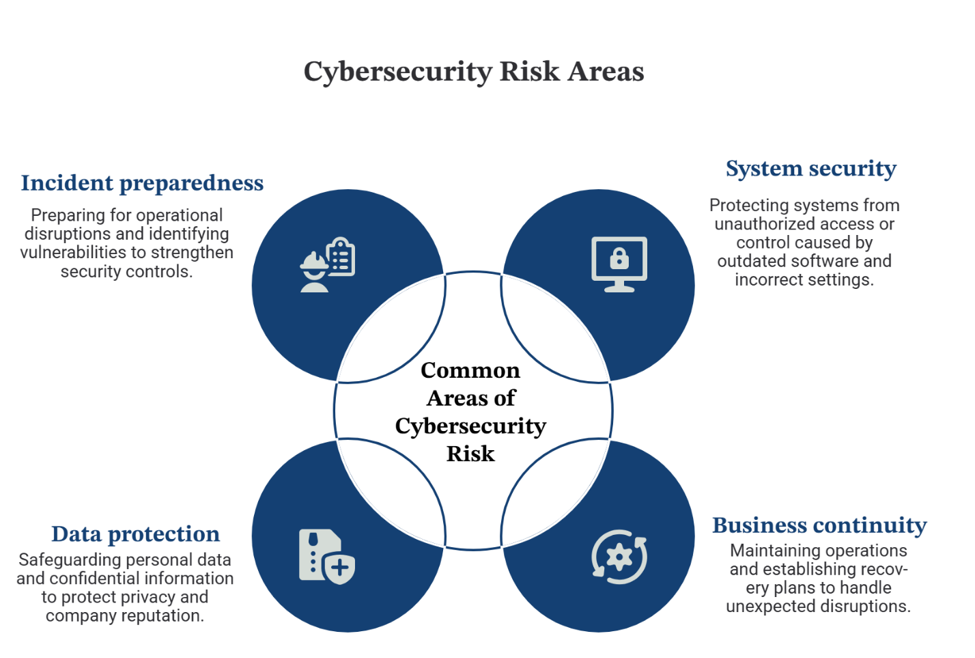
Although these cyberattacks affected different systems, they point to four common areas of cybersecurity risk: system security, business continuity, data protection, and incident preparedness. An attack can also disrupt daily operations, damage equipment, or affect essential digital services. Outdated software and incorrect settings can make it easier for attackers to access or control systems. A cyberattack can disrupt daily ongoing processes and damage equipment or affect essential digital services. When attackers access your personal data or any kind of confidential information, it can put people’s privacy and a company’s reputation at risk.
Crisis and continuity management help organizations prepare for operational disruptions and establish clear recovery plans before incidents occur. Combined with security and risk management consulting , it can support a more structured approach to identifying vulnerabilities, strengthening controls, and maintaining business operations during unexpected events.
Organizations can also benefit from threat risk assessment in India to evaluate their exposure to evolving cyber threats and prioritize appropriate safeguards. Alongside this, physical security consulting services can help address risks where digital systems interact with equipment, facilities, and essential physical operations.
How Netrika Responds to Cybersecurity Risks
When a cyberattack happens, every minute is crucial. There is not a second that is worth wasting. Businesses need to contain the threat, protect sensitive information, and restore operations without compromising critical evidence. This is where Netrika’s Digital Forensic and Incident Response (DFIR) services play a major role.
At Netrika, cybersecurity is not just about responding after an attack; it is about helping the businesses build resilience and prepare for the unexpected. With 100+ years of collective leadership experience and 1500+ clients empowered, Netrika brings to the table multidisciplinary expertise to complex security and risk challenges. Its approach focuses on identifying the source of an attack, isolating affected systems, preserving digital evidence, and supporting recovery. Netrika’s experts also analyze the vulnerabilities and recommend corrective measures to help prevent similar incidents.
The right response starts with understanding what happened, protecting the evidence, and knowing what needs to change.
FAQ
1. What is cyber resilience, and why is it important for businesses?
Cyber resilience helps businesses withstand cyberattacks, protect sensitive data, maintain essential operations, and recover quickly while minimising financial and reputational damage.
2. What are the most common causes of cyberattacks?
Common causes include outdated software, weak passwords, incorrect cloud configurations, unsecured connected devices, phishing attempts, and inadequate access controls.
3. How can businesses recover quickly after a cyberattack?
Businesses should isolate affected systems, preserve digital evidence, activate recovery plans, restore secure backups, investigate the incident, and strengthen security controls.
4. How can organizations prevent ransomware attacks and data breaches?
Organizations can reduce risks through regular security updates, employee awareness training, restricted access, independent data backups, continuous monitoring, and tested incident-response plans.
5. How does Netrika help businesses respond to cybersecurity incidents?
Netrika supports incident investigation, digital evidence preservation, threat identification, impact assessment, and recovery planning to help businesses strengthen security and resilience.
When a Cyberattack Happens, Every Minute Matters!
Respond Faster with Netrika’s Digital Forensics and Incident Response (DFIR)
From identifying the source of an attack to analyzing evidence and supporting recovery, Netrika helps organizations manage cyber incidents with a structured approach.
Website: Netrika Phone: 1800-121-300000 Email: trust@netrika.com